Why Cracking Your Neck at Your Desk Makes Pain Worse by 5pm
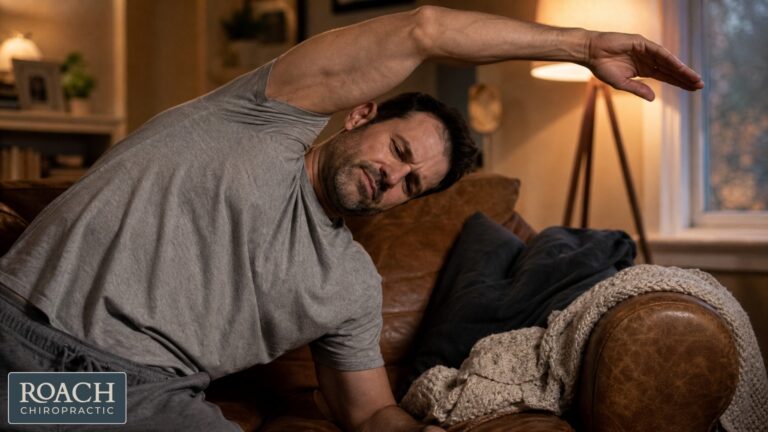
Self-cracking your neck at your desk gives you about 10–20 minutes of relief before the tension rebuilds — and every time you do it, you’re reinforcing the very muscle imbalances that caused the discomfort in the first place. By 5pm, that brief release has compounded into something worse: a stiff, aching neck that’s harder to ignore than it was at 9am.
If you work from home in Bedford or commute to a Halifax-area office, you’re not alone. Remote and hybrid work has become the norm across HRM, and neck pain in office workers is directly linked to prolonged forward head posture and static sitting — exactly the position most of us hold for six-plus hours a day. Here’s why that habitual neck crack is making things worse, and what to do instead.
Because Self-Cracking Reinforces the Problem, Not the Fix
A neck crack does not treat the cause of your tension — it temporarily releases gas from a joint under pressure, and your nervous system interprets that as relief. The muscles pulling your head forward are still tight, the ones supporting it from behind are still weak, and within minutes, the joint is under the same load again.
This pattern is the hallmark of upper crossed syndrome — a predictable muscle imbalance where the chest and front neck muscles become overactive and shortened, while the deep neck flexors and lower trapezius become inhibited. The result: your head drifts forward (craning neck), your shoulders round, and the joints at the base of your skull and mid-cervical spine are compressed all day. Upper crossed syndrome exercises and professional care address the imbalance itself — self-cracking just resets the pressure gauge without fixing the leak.
Research backs this up. A peer-reviewed systematic review on neck self-manipulation adverse events documents a range of serious outcomes including arterial dissection and stroke following self-manipulation of the cervical spine — risks that simply don’t apply to a calibrated chiropractic adjustment.
Because Your Spine’s Natural Curves Are Being Erased Hour by Hour
The spine’s natural curve — cervical lordosis, thoracic kyphosis, and the lower back curve (lumbar lordosis) — functions like a spring, distributing load evenly across discs and joints. Desk posture flattens or reverses these natural spinal curves, shifting load forward and forcing small stabilizing muscles to work beyond their capacity.
By mid-afternoon, muscle fatigue sets in. You start slouching more, your head drifts further forward, and the pressure on your cervical discs increases significantly — research suggests forward head posture of just 2–3 inches can multiply the effective weight of the head on the spine. That’s why pain escalates predictably through the day rather than staying constant.
Poor sleep posture compounds this further. If your back hurts sleeping or you wake with neck stiffness, your spine isn’t recovering overnight the way it should. For more on this connection, see how sleep position affects your joints and spine.
Because the Crack Doesn’t Tell You What’s Actually Wrong
People often ask why does my neck crack so much — and the honest answer is that frequent, unsatisfying cracking is a sign of joint instability or chronic muscle tension, not something to manually chase. The more you self-crack, the more the surrounding ligaments stretch and the less stable the segment becomes, which creates the urge to crack again. It’s a loop.
A chiropractor at Roach Chiropractic doesn’t just create a pop. A professional chiropractic adjustment applies a specific, controlled force to a targeted spinal segment that has been assessed for restricted movement — this is fundamentally different from torquing your own neck with your hands, a towel, a pillow, or a chair. The neck cracking risks explained by Healthline reinforce this distinction: DIY methods lack the precision to mobilize the correct level, and compensatory movement at adjacent segments is common.
Frequent self-cracking can also mask symptoms that deserve proper assessment. Some vertigo kinds — particularly cervicogenic vertigo — originate from dysfunction in the upper cervical spine. Chasing that crack when dizziness is present is not a safe workaround.
Because the Lower Body Pays the Price Too
Upper crossed syndrome doesn’t stay in the neck. The compensatory posture it creates — pelvis tipping forward, lumbar spine overextending — puts chronic load on the QL back muscles (quadratus lumborum), hip flexors, and the structures of the lower back. A strained QL muscle is one of the most common hidden contributors to low back pain in desk workers, and it rarely gets identified without a full postural assessment.
Over time, this chain can sensitize the sciatic nerve. If you’re already doing sciatica exercises stretches or trying to stretch sciatica with a sciatic stretch and finding only partial relief, the source may be upstream in your posture rather than in the nerve itself. The same applies if you’re dealing with hip or knee load that’s developed from years of compensating for a poorly aligned spine.
QL strengthening and a seated QL stretch can help at home — Roach Chiropractic’s guide to QL muscle strengthening and recovery stretches is a good starting point — but these work best when the spinal alignment driving the compensation has been addressed first.
What Actually Helps: Practical Alternatives to Self-Cracking
The most effective desk-worker interventions address both the muscle imbalances of upper crossed syndrome and the spinal loading patterns that drive pain by 5pm. Here are evidence-based options worth implementing today:
- McGill Big 3 exercises: The McGill Big 3 — the curl-up, side plank, and bird dog — are designed specifically to build spine-sparing core stability without loading the discs. Regular McGill Big 3 exercises reduce the muscular fatigue that leads to posture collapse in the second half of the workday. See Roach Chiropractic’s full McGill Big 3 guide for step-by-step instructions.
- Rib stretches: Opening the thoracic spine with rib stretches — a doorway stretch or a seated thoracic extension over a chair back — directly counteracts the kyphotic collapse that drives upper crossed syndrome. Even 60 seconds every hour makes a measurable difference.
- Upper crossed syndrome exercises: Chin tucks, band pull-aparts, and prone Ys target the specific muscles that become inhibited with desk posture. These are the exercises that actually reduce the urge to self-crack because they address the tension at its source.
- Joint health awareness: If you’re considering joint health supplements or joint pain supplements, omega-3 fatty acids and collagen peptides have the most consistent research support for connective tissue health — but supplements work alongside, not instead of, correcting the mechanical load on the joint.
For additional upper crossed syndrome exercises and office-specific movement breaks, the Roach Chiropractic office stretching guide has a practical routine you can do without leaving your desk.
Conclusion: Stop Chasing the Crack and Treat the Cause
The neck crack feels satisfying because your body is signalling that something needs to change — but how to crack your neck is the wrong question. The right question is: what’s driving the tension that makes you want to crack it ten times a day?
Upper crossed syndrome, lost natural spinal curves, and the cascading effects on your QL and lower body are all assessable and treatable conditions. The team at Roach Chiropractic in Bedford, NS, offers hands-on, non-invasive care specifically designed to identify and correct the postural and structural patterns keeping you in pain. Halifax-area desk workers don’t have to end every day in discomfort — you just need a plan that targets the cause, not the symptom.
Book an assessment at roachchiropractic.com or call us at 902-404-3828. Roach Chiropractic is located at 1160 Bedford Hwy, Unit 101, Bedford, NS — and we’re ready to help you start your journey to better health.
Frequently Asked Questions
What’s the difference between upper crossed syndrome and just having a stiff neck from sitting too long?
A stiff neck from a long day is a symptom — upper crossed syndrome is the structural pattern underneath it. In upper crossed syndrome, specific muscles are chronically overactive and shortened (chest, front neck) while their opposing muscles (deep neck flexors, lower trapezius) become inhibited and weak, which is why the tension rebuilds within minutes of cracking and worsens predictably through the afternoon.
If the McGill Big 3 are meant for core stability, how do they actually reduce the urge to crack my neck by the end of the workday?
The curl-up, side plank, and bird dog build spine-sparing endurance in the muscles that hold your posture upright without fatiguing — meaning your head stays over your shoulders longer before it starts drifting forward under load. That forward drift is what compresses the mid-cervical joints and creates the pressure you’re trying to release by cracking, so reducing postural collapse in the second half of the day reduces the tension that drives the habit.
How does a professional chiropractic adjustment at Roach Chiropractic differ from the neck self-manipulation techniques people use at their desks?
A chiropractic adjustment applies a controlled, specific force to a spinal segment that has been assessed for restricted movement — the chiropractor knows which level to target and why. Self-cracking with your hands, a towel, or a chair back moves whatever gives first, which is typically the most hypermobile segment rather than the restricted one, and compensatory movement at adjacent, already-unstable segments is a common result.
How often would a Bedford-area desk worker typically need to come in before the cycle of tension and self-cracking starts to break?
The frequency depends on how entrenched the postural pattern is and how consistently the home exercises are being done between visits, which is why Roach Chiropractic begins with a full postural assessment before outlining a care plan. Generally, upper crossed syndrome that’s been developing across years of desk work requires a series of adjustments alongside corrective exercise — not a single appointment — before the underlying muscle imbalances shift enough to reduce the daily urge to self-crack.
The post mentions cervicogenic vertigo as a reason not to self-crack when dizziness is present — but what should someone do if they’re already experiencing both neck pain and dizziness at their desk?
Cervicogenic vertigo originates from dysfunction in the upper cervical spine, meaning the dizziness and the neck pain share a mechanical source rather than being two separate problems — and self-cracking when that dysfunction is present can aggravate the very structures driving the vertigo. The appropriate next step is a professional assessment to determine whether the upper cervical spine is involved before any manual intervention, which is exactly the kind of evaluation available at Roach Chiropractic’s Bedford location.
SHARE THIS