Dietary Supplements for Joint Health Won’t Save You 40%
Dietary supplements for joint health are widely marketed as a fast fix for pain and stiffness — but the clinical evidence tells a more complicated story, and for many Bedford residents, relying on them alone means the underlying problem keeps getting worse.
Myth: Joint Health Supplements Deliver 40% Improvement in Pain
Reality: No major clinical trial has confirmed a consistent 40% improvement in joint pain from glucosamine or chondroitin supplements. The landmark GAIT trial, reviewed in detail by the NIH supplement research overview, found that for most participants, these supplements performed no better than placebo for reducing knee osteoarthritis pain.
The “40% better” figures you see in supplement marketing typically come from small, industry-funded studies with short follow-up windows. The Arthritis Foundation supplement guide confirms that research results on joint pain relief remain consistently mixed.
Vitamins for joint pain and stiffness — including omega-3s, turmeric, and collagen — may offer modest anti-inflammatory support as part of a broader plan. But they do not correct spinal misalignment, decompress irritated nerve roots, or restore the spine’s natural curve. For that, you need physical intervention.
Myth: Supplements Are Enough for Sciatica and Lower Back Pain
Reality: Sciatica is a mechanical problem — nerve compression caused by disc bulges, joint dysfunction, or tight muscles — and no pill resolves a mechanical problem. The top causes of sciatica all require hands-on treatment, not supplementation.
Sciatica exercises and stretches form a critical part of recovery. A proper sciatic stretch routine — including the piriformis stretch and knee-to-chest holds — relieves pressure on the sciatic nerve in a way that no supplement can replicate. Chiropractic decompression techniques further reduce disc load and restore mobility.
For active adults between 40 and 65 in Bedford who run, cycle, or golf, the quadratus lumborum is a common pain generator. A QL muscle stretch or seated QL stretch addresses this directly. Our post on DIY recovery stretches for QL pain walks you through the most effective approaches — but stretches work best when the underlying joint dysfunction has been assessed and treated first.
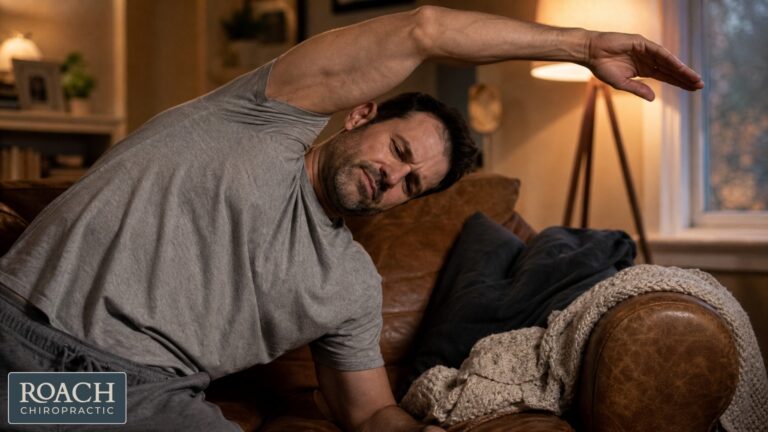
To stretch the quadratus lumborum correctly while seated: sit upright, reach one arm overhead and lean to the opposite side, hold 20–30 seconds, and repeat. It is a useful daily habit — not a substitute for care.
Myth: The Best Supplement for Joint Health Fixes Neck Problems Too
Reality: Neck pain, frequent neck cracking, and dizziness linked to the upper spine are structural issues that supplements cannot address. If you have been asking why does my neck crack so much, the answer usually involves joint restriction, muscle imbalance, or early degenerative change — none of which respond to glucosamine.
Upper cervical misalignment can trigger more than just neck stiffness. It is associated with several vertigo kinds, including cervicogenic vertigo, where disrupted proprioception from the upper cervical joints causes dizziness and balance disturbance. If you have been searching for an upper cervical chiropractor near me, the team at Roach Chiropractic in Bedford is trained in exactly this type of structural assessment.
Office workers in Bedford are particularly vulnerable here. Hours of forward head posture compress the upper cervical joints and flatten the cervical lordosis. Our guide on office worker posture mistakes covers the most common patterns we see — and why no supplement corrects them.
Myth: Vitamins for Joint Stiffness Replace Targeted Exercise Protocols
Reality: The strongest supplement for joint pain cannot replicate the structural benefits of evidence-based rehabilitation exercises. Targeted movement protocols directly restore tissue function, joint mechanics, and nervous system control.
The McGill Big 3 exercises — the curl-up, side bridge, and bird-dog — are among the most researched core stability routines for low back pain. The McGill Big 3 protect the lumbar spine by building endurance in the stabilising muscles without increasing disc load. You can find a full breakdown in our post on fixing back pain with the McGill Big 3.
For golfers and racquet sport players in the Bedford area, stretches for golfer’s elbow — including wrist flexor stretches and eccentric loading exercises — address the tendon pathology directly. Our golfer’s elbow relief stretches guide gives you a practical starting point.
Similarly, rib stretches and thoracic mobility work are the appropriate treatment for rib joint restrictions — something that regularly affects seniors and desk workers. No supplement restores rib joint mobility.
Myth: Supplements for Arthritis and Inflammation Are All You Need
Reality: The best supplements for pain and inflammation — omega-3 fatty acids, curcumin, and vitamin D — may reduce systemic inflammatory markers modestly, but they do not correct the biomechanical dysfunctions that drive chronic arthritis pain. The NCCIH arthritis treatment evidence resource confirms that physical therapies, not supplements, have the stronger evidence base for functional improvement.
For seniors in Bedford managing osteoarthritis of the knee, hip, or spine, joint health supplements taken alongside chiropractic care and targeted movement produce better outcomes than either approach in isolation. Chiropractic adjustments restore joint mechanics, reduce muscle guarding, and support the nervous system — results no supplement delivers independently.
Acupuncture also has a meaningful role here. Acupuncturing — the clinical term for therapeutic needle insertion — has demonstrated measurable effects on pain modulation through endorphin release and local tissue response. At Roach Chiropractic, integrated care that combines chiropractic adjustments with acupuncture addresses both the structural and neurological dimensions of joint pain, something no supplement regimen can replicate.
Myth: Supplements Are the Safe, Low-Effort Path to Joint Health
Reality: Supplements are low-effort, but they are not without risk — and more critically, relying on them delays effective care. The longer structural problems go unaddressed, the more the surrounding muscles compensate, the more the spine’s natural curve deteriorates, and the harder recovery becomes.
For Halifax-area patients, including those across Bedford and the surrounding communities, the Halifax chiropractors patients trust most are those who take a root-cause approach. At Roach Chiropractic Centre, located at 1160 Bedford Hwy Unit 101, that means a thorough assessment of your spine, pelvis, and nervous system — not a conversation about which supplement brand to try next.
Dietary supplements for joint health have a place as supportive tools. They are not a treatment plan.
Conclusion: Supplements Support — They Don’t Solve
Dietary supplements for joint health may reduce inflammation at the margins, but they cannot correct spinal misalignment, decompress a nerve root, restore a QL that won’t release, or fix the cervical dysfunction behind your frequent neck cracking. For Bedford residents dealing with sciatica, lower back pain, neck issues, or age-related joint deterioration, hands-on chiropractic care — combined with targeted movement like sciatic stretches, QL stretches, and the McGill Big 3 — is what actually changes outcomes.
If you are ready to address the root cause rather than mask the symptom, contact Roach Chiropractic Centre at 902-404-3828, email info@roachchiropractic.com, or book online at roachchiropractic.com. Start your journey to better health with a team that treats the whole problem — not just the pain signal.
Frequently Asked Questions
The GAIT trial found glucosamine performed no better than placebo — so why do supplement labels still claim significant pain relief?
Most supplement marketing draws on small, industry-funded studies with short follow-up periods rather than large independent trials like the GAIT study reviewed by the NIH. These smaller studies are more likely to show favourable results simply because of design limitations, not because the supplements are more effective. The Arthritis Foundation acknowledges this directly, noting that research results on glucosamine and chondroitin for joint pain relief remain consistently mixed across the broader literature.
How do I know whether my sciatica needs a piriformis stretch or chiropractic decompression — and can I use both at the same time?
Piriformis stretches and knee-to-chest holds relieve pressure on the sciatic nerve through soft tissue release, while chiropractic decompression targets the disc load and joint dysfunction that is often the root mechanical cause. These approaches are not mutually exclusive — stretching works best when the underlying joint dysfunction has already been assessed and treated, so the two methods are genuinely complementary. If your pain is persisting despite a consistent stretch routine, that is a strong indicator that the structural component has not yet been addressed.
How does cervicogenic vertigo differ from other vertigo kinds, and would an upper cervical chiropractor treat it differently than a GP would?
Cervicogenic vertigo originates from disrupted proprioception in the upper cervical joints rather than from inner ear pathology, which means it does not respond to the repositioning manoeuvres a GP might use for conditions like BPPV. An upper cervical chiropractor focuses on restoring proper alignment and joint mechanics in the top of the spine, directly addressing the source of the faulty nerve signals causing the dizziness. This structural approach is fundamentally different from medication or watchful waiting, which are the more common GP responses when imaging comes back clear.
For Bedford seniors managing knee or hip osteoarthritis, at what point does adding chiropractic care to a supplement routine make the most practical difference?
The post notes that joint health supplements taken alongside chiropractic care and targeted movement produce better outcomes than either approach alone, which suggests the combination is most valuable once pain or stiffness is interfering with daily function rather than waiting until deterioration is advanced. Chiropractic adjustments restore joint mechanics and reduce muscle guarding — changes that supplements cannot produce independently — so introducing hands-on care earlier preserves more of the functional range that osteoarthritis progressively erodes. Roach Chiropractic Centre in Bedford can be reached at 902-404-3828 to discuss what an integrated assessment would involve for your specific situation.
The post says omega-3s and curcumin may reduce systemic inflammatory markers modestly — does that mean they are still worth taking alongside the McGill Big 3 exercises, or do they add nothing on top of structured rehab?
The post positions omega-3s, curcumin, and vitamin D as supportive tools rather than treatments, which implies they occupy a different lane than structural interventions like the McGill Big 3 rather than competing with them. Reducing systemic inflammation at the margins could theoretically support tissue recovery during a rehabilitation programme, but the evidence base for physical therapies like the McGill curl-up, side bridge, and bird-dog is substantially stronger for functional improvement than for any supplement. The practical answer is that supplements do not undermine structured exercise, but they should not be used as a reason to delay or reduce the physical work that actually changes spinal mechanics.
SHARE THIS