Fix Chronic Back Pain in 10 Minutes Without a Gym or Drugs
Chronic back pain in Bedford, NS doesn’t require a gym membership, prescription medication, or hours of free time to start managing effectively — a focused 10-minute daily routine, done consistently, can produce real, lasting relief. This guide shows you exactly what to do, step by step, and explains how professional chiropractic care from a family chiropractor in Bedford amplifies every effort you make at home.

What Actually Causes Chronic Back Pain for Bedford Locals?
Chronic back pain — pain lasting more than 12 weeks — usually isn’t caused by one dramatic injury. It builds quietly, driven by repetitive mechanical stress on the spine.
If you commute along the Bedford Highway to a desk job in Halifax or Dartmouth, your spine spends hours in a compressed, forward-flexed position. Hip flexors shorten, lumbar muscles fatigue, and the discs between your vertebrae lose hydration from constant pressure. Over months, this creates the dull, persistent ache that greets you every morning.
Parents in Bedford and surrounding HRM communities face a different version of the same problem. Lifting toddlers from car seats, hunching over strollers, and carrying heavy school bags introduce repeated asymmetrical loading to the lower back and hips. These micro-stresses accumulate fast. Chiropractic care for desk workers and parents alike addresses these patterns before they become chronic.
Workplace ergonomics and spine health are inseparable. Poor chair height, monitor placement, and prolonged sitting without movement breaks all compress the lumbar spine and inhibit the deep stabilising muscles that protect your discs. The NIH non-drug back pain approaches resource confirms that movement-based strategies and spinal manipulation are among the strongest evidence-backed interventions for chronic low-back pain — more effective than prolonged rest or over-the-counter pain relievers used alone.
What You’ll Need Before You Start
Nothing expensive. Here’s the complete list:
- A yoga mat or carpeted floor
- A firm chair or wall for one balance move
- 10 uninterrupted minutes (morning works best, but any consistent time is fine)
- Comfortable clothing that doesn’t restrict your hips
No weights, no bands, no foam roller required. The goal is controlled movement through full spinal range of motion — that’s what reduces pain, not equipment.
Step 1: Diaphragmatic Breathing and Spinal Reset (90 Seconds)
Start lying on your back with knees bent and feet flat. Place one hand on your chest, one on your abdomen. Inhale slowly through your nose for four counts, letting your belly rise — not your chest. Exhale for six counts.
This isn’t just relaxation. Diaphragmatic breathing activates the deep core stabilisers — the transverse abdominis and multifidus — that support your lumbar spine during every movement you make. Most people with chronic back pain have learned to breathe shallowly into their chest, which keeps these stabilisers chronically underactive. Spend 90 seconds resetting this pattern before you move into stretching. You’ll notice your lower back release toward the floor as you exhale.
Step 2: Knee-to-Chest Stretch for Lumbar Decompression (90 Seconds)
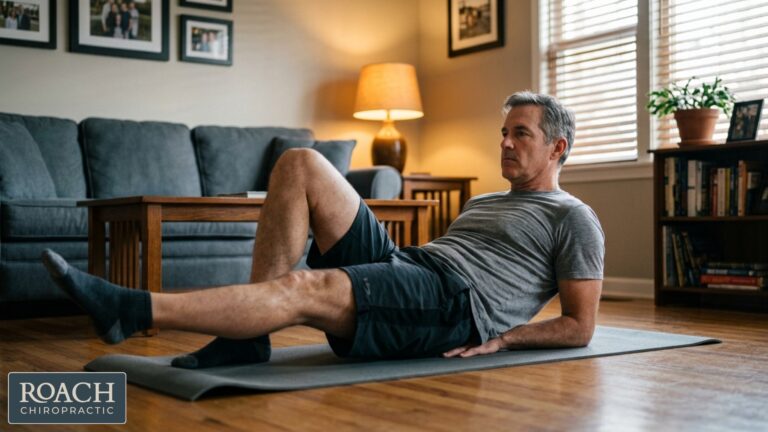
Still on your back, draw one knee slowly toward your chest and hold for 20 seconds. Switch sides. Then draw both knees in together and gently rock side to side for 30 seconds.
This movement decompresses the lumbar facet joints and gently lengthens the erector spinae — the long muscles running alongside your spine that go into protective spasm when your back hurts. For Bedford office workers who’ve been sitting at a fixed workstation all day, this single move can reduce morning stiffness significantly within two weeks of consistent practice. Refer to Roach Chiropractic’s lumbar facet exercise guide for additional variations if this position is uncomfortable initially.
Step 3: Cat-Cow Spinal Mobilisation (2 Minutes)
Move to a four-point kneeling position — hands under shoulders, knees under hips. Inhale and let your spine gently sag (cow position), lifting your head and tailbone. Exhale and round your spine upward (cat position), tucking your chin and pelvis.
Move slowly and deliberately through 10 full cycles. This exercise restores segmental mobility through the entire thoracic and lumbar spine. Each flexion-extension cycle pumps nutrient-rich fluid into the intervertebral discs — the same discs that become dehydrated and compressed after a long commute. Think of it as re-hydrating your spine from the inside. This is one of the most consistently recommended moves in non-invasive back pain treatment protocols worldwide, and for good reason: it works at the tissue level, not just the symptom level.
Step 4: Hip Flexor Lunge Stretch (2 Minutes)
From standing, step your right foot forward into a low lunge. Drop your left knee to the floor (use a folded mat for cushioning). Shift your weight gently forward until you feel a stretch through the front of your left hip. Hold 30 seconds, then switch.
Tight hip flexors — specifically the iliopsoas — are one of the most overlooked drivers of chronic lower back pain. When these muscles shorten from prolonged sitting, they pull the lumbar spine into excessive lordosis, increasing compression on the posterior disc. Releasing them daily directly reduces the mechanical load on your L4-L5 and L5-S1 discs, the two most commonly affected levels in back pain cases. Parents regularly lifting children and office workers commuting 30–40 minutes into Halifax are particularly susceptible to this pattern. For more targeted hip work, explore these five hip pain relief exercises.
Step 5: Glute Bridge Activation (2 Minutes)
Lie on your back with knees bent, feet flat and hip-width apart. Press through your heels and lift your hips until your body forms a straight line from knees to shoulders. Hold two seconds at the top, then lower slowly. Complete 12 repetitions.
Weak gluteal muscles force the lower back to compensate during every step, lift, and postural hold — which is why strengthening them is central to any chronic pain management Bedford chiropractor would recommend. The glute bridge specifically activates gluteus maximus and medius without loading the spine in compression, making it safe for people currently experiencing disc-related pain or sciatica. Johns Hopkins back pain relief specialists consistently rank targeted muscle activation alongside manual therapy as a first-line approach for chronic low-back pain management.
Step 6: Thoracic Rotation Stretch (2 Minutes)
Sit sideways in a firm chair. Place both hands on the back of the chair and rotate your upper body toward the back, using the chair for gentle overpressure. Hold 20 seconds on each side, completing three rotations per side.
Most people focus exclusively on their lower back, but restricted thoracic (mid-back) mobility forces the lumbar spine to compensate — increasing wear at the segments already under stress. Restoring thoracic rotation is a critical component of posture correction and one that a posture correction chiropractor assesses during every initial examination. For HRM desk workers, this stretch counteracts the closed-chest, forward-shoulder position that develops after hours of keyboard work. It also directly reduces the tension patterns that lead to tension headaches and neck pain.
How Spinal Alignment Affects Your Pain Levels
Spinal alignment directly influences how much mechanical load each disc, nerve, and joint carries — and misalignment amplifies pain signals even when the underlying tissue damage is minor.
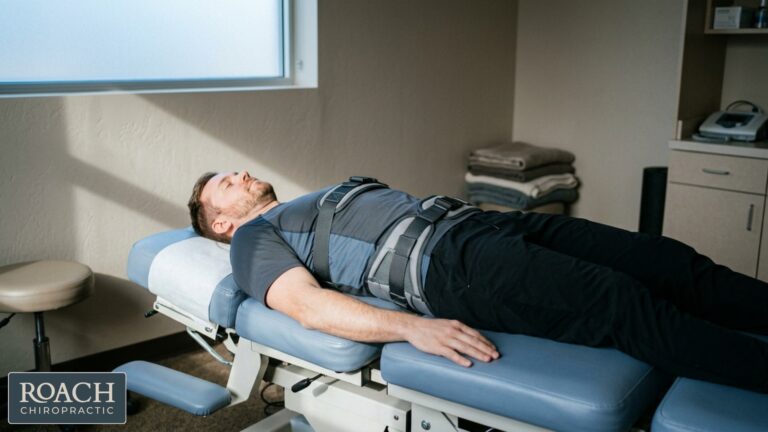
When vertebrae are not moving correctly through their full range, the surrounding muscles tighten protectively. This creates a cycle: joint restriction leads to muscle guarding, muscle guarding limits movement, and limited movement accelerates joint degeneration. The spinal adjustment benefits of professional chiropractic care break this cycle by restoring normal joint mechanics through precise, hands-on manipulation — something no home stretch can fully replicate.
A misaligned spine also affects the nervous system directly. The spinal cord and nerve roots pass through and between the vertebrae; restricted spinal segments can irritate these structures, producing pain that radiates into the hips, legs, or arms. This is the mechanism behind sciatica, hip pain chiropractic care addresses, and referred shoulder and neck pain — and it’s why nervous system treatment is central to the chiropractic model at Roach Chiropractic Centre in Bedford.
Research published and reviewed by UT Southwestern Medical Center physicians confirms this approach: drug-free back pain treatments, including spinal manipulation and targeted exercise, consistently outperform passive approaches like prolonged rest and medication dependency for long-term outcomes.
Why Non-Invasive Treatment Outperforms Quick Fixes
Non-invasive back pain treatment produces better long-term outcomes than pain medication or surgery for the vast majority of chronic back pain cases — because it addresses the structural and functional cause, not just the symptom.
Anti-inflammatory medications reduce the perception of pain temporarily. They do nothing to restore disc hydration, correct spinal mechanics, strengthen stabilising muscles, or improve movement patterns. Over time, relying on them exclusively allows the underlying problem to worsen while masking the warning signals your body is sending.
Surgery carries real risks, significant recovery time, and — for most common causes of chronic back pain — produces outcomes no better than structured conservative care at 12-month follow-up, according to multiple systematic reviews. For conditions like disc herniation, sciatica, and facet joint syndrome, a hands-on chiropractic treatment approach combined with targeted exercise is the evidence-supported first choice.
At Roach Chiropractic Centre in Bedford, the focus is on traditional, hands-on chiropractic care that supports your body’s natural ability to heal. This aligns directly with holistic pain management philosophy: treat the whole person, correct the underlying dysfunction, and support long-term health — not just short-term symptom relief. Preventive chiropractic wellness plans take this further by maintaining spinal health proactively, reducing the frequency and severity of flare-ups over time.
When Your Home Routine Isn’t Enough
Home stretches and mobility work are powerful — but they have a ceiling. If your pain is severe, worsening, or affecting your daily function, professional assessment is the right next step.
See a chiropractor if you experience any of the following:
- Pain that radiates into your leg below the knee (possible sciatica or disc herniation)
- Numbness, tingling, or weakness in your legs or feet
- Pain that is worse lying down or wakes you at night
- Back pain following an auto accident, fall, or impact
- Pain that hasn’t improved after four to six weeks of consistent home care
These signs indicate the need for a professional structural assessment. At Roach Chiropractic Centre, the chiropractors evaluate spinal mechanics, neurological function, and movement patterns to identify exactly where the problem originates — whether that’s a lumbar disc, an SI joint, a hip flexor imbalance, or a combination of factors. For Bedford and HRM residents, this level of personalised assessment is available at 1160 Bedford Hwy Unit 101. Call 902-404-3828 to book.
For patients dealing with conditions beyond general back pain — including prenatal chiropractic needs during pregnancy, pediatric chiropractic concerns for children, sports injury chiropractic care for athletes training in Halifax and Dartmouth, or chiropractic care for arthritis pain in active seniors — Roach Chiropractic offers a full range of family-centred services. Natural pain relief in Bedford doesn’t have to mean managing symptoms alone.
Conclusion
Ten minutes a day — six deliberate moves, done consistently — can meaningfully reduce chronic back pain by restoring spinal mobility, activating key stabilising muscles, and breaking the tension-restriction cycle that drives most cases of low-back pain in Bedford desk workers, parents, and commuters.
The routine above is a genuine starting point, not a placeholder. But lasting relief — especially for pain that has been present for months or years — combines daily home practice with professional chiropractic care that addresses the structural issues home stretching cannot reach. Small, consistent habits paired with expert spinal assessment produce the lasting change that quick fixes never deliver.
If you’re ready to go beyond stretching and get to the root of your back pain, Roach Chiropractic Centre in Bedford, NS is here to help. Visit roachchiropractic.com or call 902-404-3828 to book your assessment with a trusted back pain chiropractor in Nova Scotia. Your journey to better health starts with one appointment.
Frequently Asked Questions
What is the difference between the multifidus and the transverse abdominis, and why do both matter for lumbar support?
The transverse abdominis is a deep abdominal muscle that wraps around the trunk like a corset, while the multifidus runs along the spine itself and controls segmental vertebral stability. Together, they form the primary deep stabilising system for the lumbar spine — the same system that diaphragmatic breathing reactivates before you begin stretching. Most chronic back pain sufferers have learned breathing patterns that keep both muscles chronically underactive, which is exactly why the 90-second breathing reset is the first step in the routine rather than an optional warm-up.
If I work a desk job in Halifax with a 30-minute commute on the Bedford Highway, should I do this routine before or after work?
Morning practice is recommended because it decompresses the lumbar facet joints and rehydrates the intervertebral discs before they spend hours under sustained compressive load from sitting and commuting. That said, a consistent time matters more than the perfect time — doing the cat-cow and hip flexor lunge in the evening is significantly more effective than skipping the routine waiting for an ideal morning window. If your commute is particularly long, adding the thoracic rotation stretch at your desk midday directly counteracts the closed-chest posture that builds during keyboard work.
How does daily hip flexor stretching compare to taking anti-inflammatory medication for the disc compression at L4-L5 and L5-S1?
Anti-inflammatory medication reduces pain perception but does nothing to release the iliopsoas shortening that pulls the lumbar spine into excessive lordosis and increases posterior disc compression at L4-L5 and L5-S1. Releasing tight hip flexors daily through the low lunge stretch directly reduces the mechanical load driving that compression — addressing the structural cause rather than masking the symptom. Multiple systematic reviews cited in the post confirm that movement-based approaches produce better 12-month outcomes than medication dependency for these common disc-level conditions.
How many weeks of this 10-minute routine should someone complete before booking a chiropractic assessment at Roach Chiropractic Centre in Bedford?
The post identifies specific red flags — pain radiating below the knee, worsening symptoms, or pain affecting daily function — that warrant professional assessment immediately rather than after a trial period at home. For pain that is manageable but persistent, the knee-to-chest stretch alone is noted to reduce morning stiffness within two weeks of consistent practice, which gives a reasonable baseline for gauging whether home work is sufficient. If measurable improvement isn’t occurring by that point, or if symptoms are progressing, professional chiropractic examination is the appropriate next step rather than extending the home-only approach.
If thoracic restriction forces the lumbar spine to compensate and accelerates wear at already-stressed segments, can the six-step routine reverse existing joint degeneration or only prevent further damage?
The routine — particularly the cat-cow mobilisation and thoracic rotation stretch — works primarily by restoring movement and reducing the ongoing mechanical stress that accelerates degeneration, rather than reversing structural changes already present in the joint. Intervertebral discs can partially rehydrate with consistent movement-based decompression, but established facet joint degeneration or disc height loss is not reversed by home exercise alone. This is precisely the limitation the post points to when explaining why professional spinal adjustment is necessary to restore normal joint mechanics through precise manipulation — something that addresses the cycle of joint restriction and muscle guarding at a level home stretching cannot fully reach.
Related: sciatic stretch mistakes that add weeks to your sciatica recovery
Related: helpful tips for living with chronic pain
Related: chiropractic vs physiotherapy for lower back pain
SHARE THIS