How to Do McGill Big 3 Without Fear of Reinjuring Your Back
The McGill Big 3 exercises — the curl-up, bird dog, and side plank — are a clinically supported set of spinal stabilization movements designed to build endurance in the muscles that protect your lower back without loading the spine in ways that risk reinjury. For active adults, office workers, and parents in Bedford managing daily strain, these three movements can be performed safely at home in roughly 10–15 minutes when you follow correct technique from the start.
What You’ll Need Before You Begin
You need a firm, flat surface (a yoga mat on a hard floor works well), enough clear space to extend one arm and one leg fully, and an honest awareness of your current pain level. If your back hurts sleeping most nights, you are recovering from a strained QL muscle, or you have been diagnosed with a disc herniation, get a professional assessment first — more on that below.
It also helps to understand two structural issues that quietly affect how everyone performs these exercises:
- Spine natural curve / natural spinal curves: The lumbar spine has a gentle inward lower back curve called lordosis. Every McGill Big 3 exercise is built around maintaining — never flattening — this curve.
- Upper crossed syndrome: Tight chest and neck muscles paired with weak deep neck flexors and lower trapezius create a forward-head, rounded-shoulder posture. This pattern — extremely common in office workers and people who spend time craning neck forward at screens — causes the upper back to compensate during exercises, reducing effectiveness and increasing strain. Pairing your McGill routine with upper crossed syndrome exercises for the neck and thoracic spine will accelerate results.
Step 1: Master the Modified Curl-Up
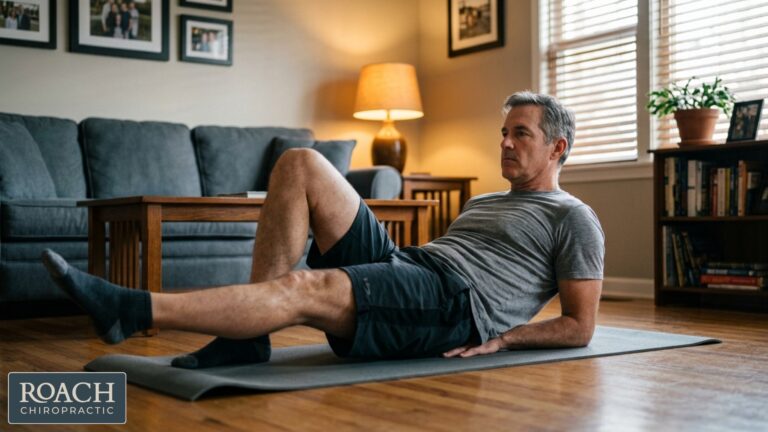
The modified curl-up builds endurance in the rectus abdominis while keeping compressive spinal load low. Lie on your back with one knee bent and one leg flat. Place both hands, palms down, under your lower back to preserve the spine natural curve — do not flatten it into the floor.
Lift only your head and shoulders a few centimetres, hold for 7–10 seconds, then lower slowly. Perform 3 sets: 6 reps, 4 reps, 2 reps (a descending ladder McGill recommends to build endurance without fatigue-related form breakdown).
Common mistake: tucking the chin and curling the whole upper back. This is a small, controlled lift — your shoulder blades barely leave the ground. Think “stiffen the core, then rise,” not “crunch.”
Step 2: Build Stability With the Bird Dog
The bird dog is the most effective of the three McGill Big 3 exercises for training the muscles along the QL back region — the quadratus lumborum — without the high shear forces that aggravate a strained QL muscle. Start on hands and knees, wrists directly under shoulders, knees under hips.
Brace your core gently, then extend the opposite arm and leg simultaneously until both are level with your torso. Hold 7–10 seconds, return slowly, and sweep the elbow and knee together beneath your body before repeating. Three sets of the same descending ladder (6-4-2) per side.
Common mistake: rotating the hips to reach higher. Keep both hips level — imagine balancing a cup of water on your lower back. QL strengthening happens through isometric control here, not range of motion. For targeted QL muscle strengthening work and a seated QL stretch to complement this step, see Roach Chiropractic’s dedicated guide on QL pain recovery stretches.
Step 3: Hold the Side Plank
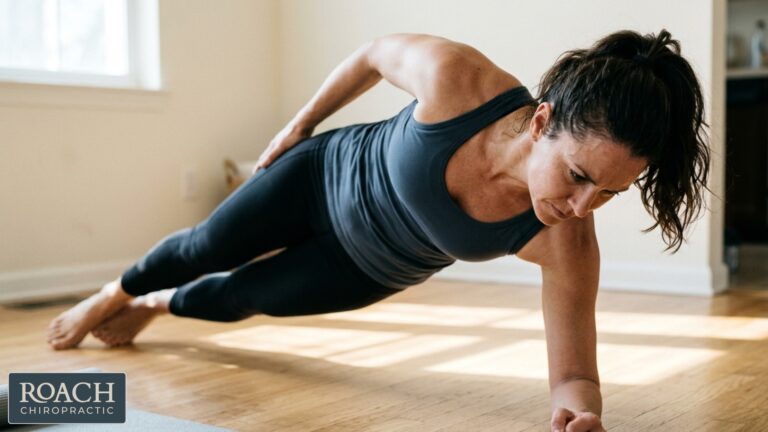
The side plank trains the quadratus lumborum and obliques — the lateral stabilizers that prevent lateral spinal buckling — in a way no other low-load exercise replicates. Lie on your side, prop yourself on your elbow (forearm on the floor, elbow beneath the shoulder), and lift your hips so your body forms a straight line.
Beginners can keep the bottom knee on the floor. Hold for 7–10 seconds per rep, using the same 6-4-2 descending ladder per side.
Common mistake: letting the hips sag or pike. Both collapse the lateral support the exercise is meant to build. If you feel sharp pinching in the lower back, drop back to the knee-supported version and build from there.
Research published in a Spinal Stabilization Exercise Research randomized controlled trial found that spinal stabilization exercises significantly reduced pain intensity and disability in adults with chronic low back pain — exactly the outcome the McGill Big 3 are designed to produce. The McGill Big 3 ACE Overview from the American Council on Exercise further explains how spine endurance training specifically reduces reinjury risk compared to traditional crunches or sit-ups.
How Upper Crossed Syndrome and Neck Issues Affect Your Form
Upper crossed syndrome directly compromises your McGill Big 3 technique by causing the neck to jut forward during the curl-up and the shoulders to round during the bird dog. If you notice a persistent neck crack or find yourself asking why does my neck crack so much during or after these exercises, poor cervical alignment is likely the cause — not the exercise itself.
Resisting the urge to learn how to crack your neck manually is important here. Self-manipulation without understanding your underlying alignment can aggravate existing tension rather than relieve it. If neck cracking is frequent and accompanied by headaches or dizziness — including certain vertigo kinds linked to the cervical spine — a chiropractic assessment is the appropriate next step.
Complementary Habits That Support Your McGill Routine
The McGill Big 3 work best as part of a broader approach to spinal health. A few habits worth adding:
- Sciatic stretch / sciatica exercises stretches: A daily sciatic stretch — such as a supine piriformis stretch — relieves the nerve tension that can make back exercise feel threatening. Roach Chiropractic has a full library of sciatica exercises for home use.
- Rib stretches: Thoracic mobility is often the missing link in spinal rehab. Stiff ribs limit rotation, forcing the lumbar spine to compensate. Simple rib stretches in a doorway or over a foam roller restore that range of motion safely. You can also explore Roach’s resource on rib cage pain exercises.
- Joint health supplements / joint pain supplements: Omega-3 fatty acids, collagen peptides, and glucosamine have evidence supporting joint tissue health. These joint health supplements don’t replace exercise, but they can support the connective tissue your stabilizers rely on — especially relevant for active adults over 40. Cellular energy at the tissue level also depends on adequate magnesium and B-vitamin status, so a conversation with your healthcare provider about foundational nutrition is worthwhile.
- Sleep position: If your back hurts sleeping, a pillow between the knees (side-lying) or under the knees (back-lying) preserves the lower back curve McGill’s exercises are training you to maintain while awake.
- Golfers elbow awareness: For patients who also deal with elbow pain, the bird dog’s wrist-bearing load can aggravate it. Modify by performing the exercise on fists or use stretches for golfers elbow to manage this before exercise.
When to Seek Guidance From Halifax Chiropractors Before Starting
You should consult a chiropractor before beginning the McGill Big 3 if you have acute disc herniation, unresolved radiculopathy, recent spinal surgery, or fracture history. The NIH Back Pain Health Guide reinforces that safe activity guidance from a qualified clinician is essential when pain is severe, recent, or accompanied by neurological symptoms such as leg weakness or bladder changes.
For patients in the Bedford and Halifax area, the team at Roach Chiropractic Centre provides hands-on assessments that identify whether your natural spinal curves are compromised, whether upper crossed syndrome is affecting your mechanics, and whether the McGill Big 3 are the right starting point or need to be modified for your specific presentation. Halifax chiropractors who offer this kind of individualized approach give you a clear, safe starting point rather than generic programming.
Conclusion
The McGill Big 3 can be performed safely without fear of reinjury when you maintain your natural lower back curve, start with the beginner descending-ladder rep scheme, and address any upper crossed syndrome or cervical alignment issues alongside the routine. Most people working with a qualified practitioner notice meaningful improvements in spinal stability and reduced daily pain within four to six weeks of consistent practice.
Ready to start with confidence? Book an assessment with Roach Chiropractic Centre at 1160 Bedford Hwy, Unit 101, Bedford, NS. Call 902-404-3828, email info@roachchiropractic.com, or visit roachchiropractic.com to take the first step toward a stronger, more resilient spine.
Frequently Asked Questions
Why do the McGill Big 3 use a 6-4-2 descending rep ladder instead of standard sets of equal reps?
The descending ladder — 6 reps, then 4, then 2 — is Dr. McGill’s method for building muscular endurance while preventing the form breakdown that happens when fatigued muscles start compensating. Each set uses the same 7–10 second hold per rep, so total time under tension remains meaningful without accumulating the fatigue that causes the lumbar curve to collapse mid-exercise. This structure is deliberately different from hypertrophy training; the goal is spinal endurance, not muscle size.
My hips keep rotating when I try to extend my arm and leg in the bird dog — what specifically is going wrong?
Hip rotation during the bird dog almost always means you are prioritizing reach over control, lifting the leg higher than your torso can stabilize. The fix is to reduce the range of motion until both hips stay level — McGill’s cue of imagining a cup of water balanced on your lower back is a useful mental anchor. The quadratus lumborum strengthening this exercise targets happens through isometric control at a neutral position, not through how high you can extend your limbs.
How does the modified curl-up differ from a standard crunch in terms of spinal load, and why does that distinction matter for someone with a disc herniation?
A standard crunch flattens the lumbar lordosis into the floor and generates significant compressive and shear forces on the lumbar discs — forces that can aggravate an existing herniation. The modified curl-up places hands under the lower back specifically to preserve the natural inward curve, keeping disc load low while still training the rectus abdominis. For someone with a diagnosed disc herniation, this structural difference is the reason the McGill version is a clinically supported starting point rather than a contraindicated one — though a professional assessment before beginning is still recommended.
How soon after starting the McGill Big 3 should Bedford-area patients expect reduced daily back pain, and how frequently should the routine be performed each week?
Most people working with a qualified practitioner notice meaningful improvements in spinal stability and reduced daily pain within four to six weeks of consistent practice. The routine itself takes roughly 10–15 minutes, making daily practice realistic; McGill’s research supports performing these exercises daily rather than on an every-other-day resistance-training schedule, because they train endurance and motor control rather than muscle tissue that needs recovery time between sessions.
If upper crossed syndrome is affecting my bird dog form, should I fix the postural issue first or can I work on both at the same time?
The post recommends pairing your McGill routine with upper crossed syndrome exercises for the neck and thoracic spine simultaneously rather than sequentially — the two reinforce each other rather than competing. However, if rounding shoulders are actively causing you to lose neutral spine position during the bird dog, performing even a short upper crossed syndrome warm-up beforehand can meaningfully improve your mechanics within the same session. A hands-on assessment at Roach Chiropractic can confirm whether your specific upper crossed presentation needs to be addressed as a prerequisite or can be run alongside the McGill program from day one.
SHARE THIS