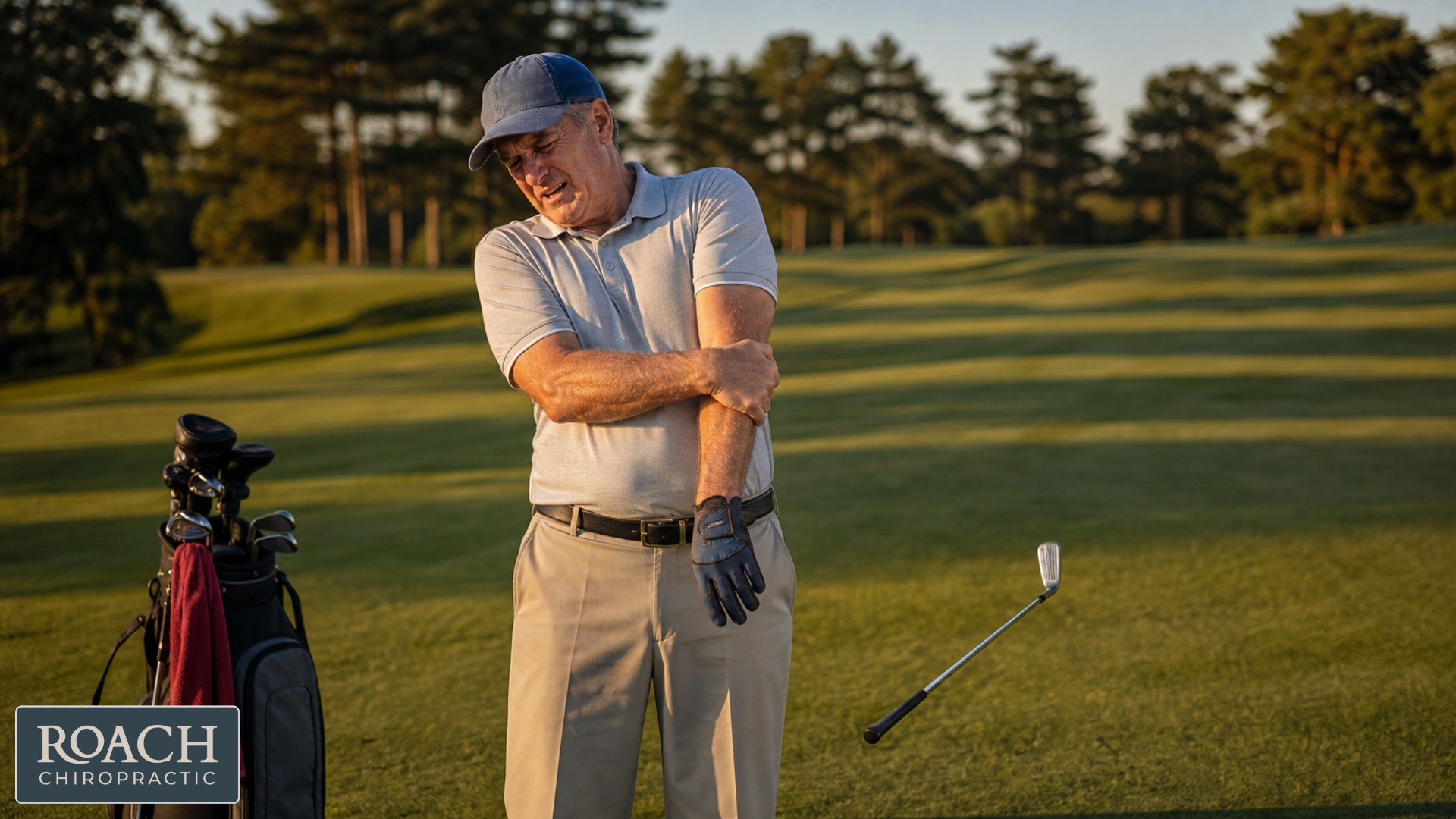
What Golfers With Elbow Pain Learn Before Buying Supplements
Golfers with elbow pain usually assume the problem lives in the elbow, so they buy joint supplements first. In most cases the real driver is mechanical: a weak or tight quadratus lumborum (QL), a lost or exaggerated curve in the lower back, and a golf swing that compensates by overloading the forearm tendons. Before spending money on a bottle of glucosamine or fish oil, it pays to test movement and function first, because supplements can support joint tissue but they cannot fix a swing pattern or a spine that isn’t moving the way it should.
This guide is written for golfers and active adults in the Bedford, Nova Scotia area, particularly those over 40 who notice elbow soreness that keeps returning no matter how many rounds they sit out. Here’s what it covers:
- Why golfer’s elbow pain often starts in the lower back and core, not the joint itself
- What dietary supplements for joint health can and cannot realistically do
- How to test for an arched or flattened lower back at home
- QL stretch and strengthening techniques, plus rib stretches for rotation
- The McGill Big Three exercises for golfers with recurring back and arm pain
- How to tell if sciatica is behind your referred pain, with standing stretch options
- Targeted stretches and exercises for medial epicondylitis (golfer’s elbow)
- When spinal decompression or gentle adjustments help more than pills or injections
Why Does Golfer’s Elbow Pain Often Start in the Lower Back?
Golfer’s elbow pain frequently originates from a weak or overly tight quadratus lumborum muscle and a compromised core, which forces the swing to compensate through the forearm and wrist. When the QL and deep core muscles cannot stabilize the pelvis during rotation, the arms and hands take on load they were never designed to absorb, particularly at impact.
We see this often at Roach Chiropractic Centre in Bedford: a golfer in their 50s comes in describing elbow pain that flares every time they play nine holes at a local course, assuming it’s simple tendon wear. On assessment, the pattern is almost always the same: a stiff thoracic spine, a QL that fires late, and a swing that “reaches” through the ball instead of rotating through the hips. The elbow is where the pain shows up, but the lower back and core are where the mechanical fault begins.
This matters because treating the elbow alone, whether with rest, bracing, or supplements, rarely resolves pain that keeps returning after every round. Addressing the swing chain, starting with the spine and core, is what actually changes the pattern long term.
What Can Dietary Supplements for Joint Health Actually Do?
Dietary supplements for joint health can support cartilage nutrition and reduce mild inflammation over weeks to months, but they cannot correct a mechanical imbalance, weak muscle, or poor swing pattern causing repetitive strain. Glucosamine, chondroitin, and omega-3 fish oil are among the most researched options, and some people report modest relief from joint stiffness after consistent use over eight to twelve weeks.
If you’ve searched for the best joint supplement for knees, the strongest supplement for joint pain, or the most effective joint supplement for arthritis in hands, the honest answer is that results vary widely by individual and none of them reverse structural wear. The three vitamins most often discussed for arthritis, vitamin D, vitamin C, and vitamin K2, play a supporting role in bone and cartilage health, but they work alongside movement and strength, not instead of it.
A supplement for joint pain can be a reasonable part of an overall plan, especially for older adults managing joint and mobility changes. But for a golfer whose elbow pain traces back to a compensating swing and an unstable core, the supplement bottle addresses a symptom while the mechanical cause keeps loading the tendon every time the club comes through impact.
How Do You Test for an Arched or Flattened Lower Back?
You can get a rough read on your lower back curve by lying flat on your back on a firm surface and sliding a hand underneath your lumbar spine. If your hand slides in with excess space and your low back is noticeably lifted off the floor, you likely have an arched lower back (excessive lordosis); if your hand barely fits and your back is pressed flat, you may have a flattened curve.
The natural curves of the spine, the neck’s forward curve, the mid-back’s backward curve, and the lower back’s forward curve, exist to absorb load and distribute force evenly through the body. When the curve in the lower back becomes exaggerated or flattened, the pelvis tilts out of neutral, the QL and hip flexors tighten or lengthen abnormally, and the swing compensates by pulling more through the arms.
Golfers asking how to fix a lower back arch usually need a combination of core stabilization, hip mobility work, and postural retraining rather than passive stretching alone. A chiropractic assessment can confirm which pattern you’re dealing with and rule out whether the arch is muscular, positional, or linked to disc or joint restriction, which changes the corrective approach significantly.
QL Stretch and Strengthening Techniques for Golfers
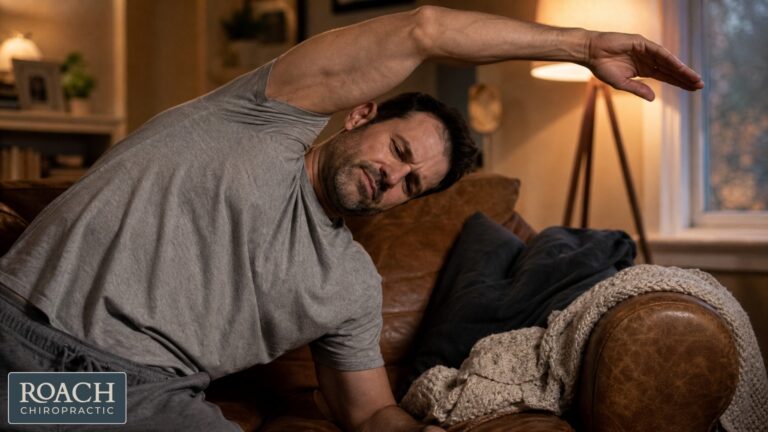
A quadratus lumborum stretch lengthens the muscle running from the pelvis to the lowest rib, and it’s one of the most useful tools for golfers whose swing is limited by lower back tightness. A simple QL muscle stretch involves standing tall, reaching one arm overhead, and leaning gently to the opposite side while keeping the hips level, holding for 20 to 30 seconds per side.
Rib stretches that open the side body, such as a seated side bend with a slow exhale at end range, complement QL work by improving rotation through the ribcage, which many golfers need more than they need extra shoulder mobility. Strengthening the QL matters just as much as stretching it; side planks and standing cable or band pull-aparts help the muscle stabilize the pelvis during the swing instead of just moving it.
A common mistake is stretching a QL that’s actually weak, not tight, which can make the area feel looser temporarily while doing nothing to fix the underlying instability. This is why testing function, not just flexibility, matters before building a home program.
What Are the McGill Big Three Exercises for Golfers?
The McGill Big Three exercises, the modified curl-up, the side plank, and the bird dog, were developed by spine researcher Dr. Stuart McGill to build core endurance without loading the spine into painful positions. For golfers with recurring back or elbow pain, these three movements retrain the deep core to stabilize the trunk during rotation, which reduces the compensatory pull through the forearms.
The modified curl-up trains the abdominals isometrically with one knee bent, avoiding the repeated spinal flexion of a traditional sit-up. The side plank builds lateral core and QL endurance, directly supporting the muscle discussed above. The bird dog, performed slowly from hands and knees with opposite arm and leg extension, teaches the spine to stay stable while the limbs move, which mirrors what happens during a golf swing.
Most golfers benefit from two to three sets of 8 to 10 repetitions per side, three to four times a week, holding each position for 8 to 10 seconds. Consistency over several weeks matters more than intensity here; these are endurance exercises, not maximal strength drills.
Could Sciatica Be Causing Your Referred Pain?
Sciatica can refer pain, tingling, or weakness down the leg and sometimes into the hip and lower back region that golfers mistake for simple muscle tightness, and it often worsens with the rotational load of a golf swing. If your lower back pain travels below the knee, or if you notice numbness alongside the ache, sciatic nerve irritation is worth ruling out before assuming it’s purely muscular.
Sciatica stretches standing are useful for golfers who spend long periods upright on the course; a standing figure-four stretch against a wall, or a standing hamstring stretch with a slight forward hinge, can reduce nerve tension without requiring a mat. General sciatica stretching should always stay within a pain-free range; pushing into sharp or radiating pain typically aggravates the nerve rather than releasing it.
ITB stretches for hip pain are often grouped with sciatica management because a tight iliotibial band can mimic similar referred discomfort along the outer hip and thigh. A standing ITB stretch, crossing the affected leg behind the other and leaning away from that side, can help differentiate true sciatic involvement from simple lateral hip tightness, though a proper assessment gives a clearer answer.
Stretches for Golfer’s Elbow and Medial Epicondylitis
Stretches for golfer’s elbow target the flexor tendons on the inside of the forearm, which become inflamed with medial epicondylitis from repetitive wrist flexion during the swing. A basic wrist flexor stretch, extending the arm with the palm up and gently pulling the fingers back with the opposite hand, held for 20 to 30 seconds, is a common starting point once acute pain has settled.
Exercises for medial epicondylitis typically progress from stretching to eccentric strengthening, such as slowly lowering a light dumbbell through wrist flexion, which research consistently shows helps tendons remodel and tolerate load again. The golfer’s elbow symptoms guide from Mayo Clinic outlines how repetitive wrist and finger use drives this condition, while the Johns Hopkins condition overview details risk factors worth knowing before you self-treat.
What often gets missed is that the forearm keeps flaring because the swing keeps forcing compensation from an unstable core and lower back. Elbow-specific exercises calm the tendon locally, but pairing them with QL and core work, as covered above, addresses why the tendon keeps getting overloaded in the first place. The NIH clinical research summary on medial epicondylitis supports this combined approach, noting that conservative, activity-modifying care performs well for most golfers and workers.
When Do Spinal Decompression or Gentle Adjustments Help More Than Pills?
Spinal decompression and gentle chiropractic adjustments help more than oral medication or supplements when the underlying issue is joint restriction, disc pressure, or a mechanical swing fault, because these approaches address movement directly rather than masking discomfort chemically. Decompression, whether manual or table-assisted, gently creates space between vertebrae to relieve pressure on discs and nerve roots, which can ease the referred pain discussed in the sciatica section above.
Gentle adjustments restore joint motion in the spine and ribs, often improving rotation for the golf swing within a handful of visits, though timelines vary by individual and how long the restriction has been present. Patients sometimes ask whether the audible neck crack heard during an adjustment is necessary or risky; the sound is simply gas releasing from the joint capsule and is a normal, harmless part of many adjustments, not an indicator of force or damage.
Are cortisone shots safe for golfer’s elbow? Cortisone injections can reduce inflammation and provide short-term relief, but repeated use has been associated with tendon weakening over time, which is why most clinicians reserve them for short-term flare management rather than a long-term fix. On the topic of passive therapies, some clinics offer water-based treatments and ask what is hydrotherapy massage or what is water massage; these use water pressure or temperature to relax surface muscle tension temporarily. At Roach Chiropractic Centre, we focus instead on hands-on, non-invasive assessment and adjustment, because passive water-based relief doesn’t correct the QL weakness, spinal curve fault, or swing compensation driving the pain in the first place.
Checklist: What Bedford Golfers Should Try Before Buying Supplements
Before reaching for another bottle of joint supplements, run through this checklist to see whether a mechanical issue is the real cause of your elbow pain.
- Test your lower back curve using the hand-slide method to check for an arched or flattened lumbar spine
- Try a quadratus lumborum stretch and note whether your swing rotation improves afterward
- Build in the McGill Big Three exercises three to four times a week for core endurance
- Rule out sciatic referral if pain travels below the knee or includes numbness
- Add wrist flexor stretches and eccentric strengthening for the forearm tendon itself
- Ask a chiropractor whether decompression or gentle adjustment could address the root mechanical fault before considering cortisone injections
Golfers with elbow pain who work through this list often find that the forearm calms down once the lower back, core, and swing pattern are corrected, with or without a supplement added on top. If you’re in the Bedford area and recurring golfer’s elbow keeps interrupting your rounds, Roach Chiropractic Centre offers hands-on, non-invasive assessment to find the mechanical cause rather than guessing with pills first. Call 902-404-3828, email info@roachchiropractic.com, or visit roachchiropractic.com to book an assessment at our Bedford Hwy clinic and start your journey to better health.
Frequently Asked Questions
What’s the difference between a tight QL and a weak QL if the stretch feels the same either way?
A tight quadratus lumborum restricts rotation and often feels stiff at end range, while a weak QL fatigues quickly and fails to stabilize the pelvis during the swing, even though stretching it can temporarily create a similar sense of looseness. Stretching a QL that’s actually weak can leave the area feeling more relaxed while doing nothing to correct the instability causing your elbow pain, which is why a functional assessment matters before you build a home stretching routine.
How often should I do the McGill Big Three if I’m also doing elbow-specific stretches?
Most golfers benefit from pairing both routines: the McGill Big Three (modified curl-up, side plank, bird dog) two to three sets of 8 to 10 reps per side, three to four times a week, alongside wrist flexor stretches and eccentric strengthening for the elbow done most days once acute pain has settled. The core work addresses why the tendon keeps getting overloaded, while the elbow exercises calm the tendon itself, so skipping either piece tends to slow progress.
Should I try spinal decompression or a cortisone shot first for golfer’s elbow that keeps coming back?
Cortisone injections can reduce inflammation and provide short-term relief, but repeated use doesn’t address a mechanical swing fault or joint restriction driving the problem. Spinal decompression and gentle adjustments target the underlying movement issue directly, which makes them a more appropriate first step when the elbow pain traces back to a stiff thoracic spine or an unstable core rather than isolated tendon damage.
How much does a chiropractic assessment cost for golfer’s elbow linked to lower back issues at Roach Chiropractic?
Pricing depends on the scope of the initial evaluation, since assessing golfer’s elbow tied to lower back and core dysfunction typically involves testing spinal curve, QL function, and swing mechanics rather than a single-issue exam. Contacting Roach Chiropractic Centre in Bedford directly is the best way to get current rates and confirm what your specific assessment will include.
What if my elbow and lower back stretches aren’t helping and I still have pain radiating down my leg?
Pain that travels below the knee, or comes with numbness, points toward possible sciatic nerve irritation rather than simple muscle tightness, and it won’t respond to QL or elbow stretches designed for mechanical strain. Standing stretches like the figure-four or standing hamstring stretch may ease nerve tension temporarily, but a proper assessment is needed to rule out disc or joint involvement and to differentiate sciatica from a tight ITB mimicking similar symptoms.
SHARE THIS